LogicWeb • AI comparison guide
ChatGPT vs Grok is a practical choice between two broad AI assistants, not a contest with one permanent winner. A site owner may need a careful migration checklist in the morning, a product illustration at lunch and a social campaign brief in the afternoon. The right tool is the one that completes that combination with the least correction and the clearest evidence.
The quick answer
Choose ChatGPT for a mixed workflow that combines writing, files, research and images. Consider Grok when searching public X conversations or creating short AI videos is central to your work. These are workflow recommendations, not a measured ranking of intelligence.
In this guide
ChatGPT vs Grok: comparison at a glance
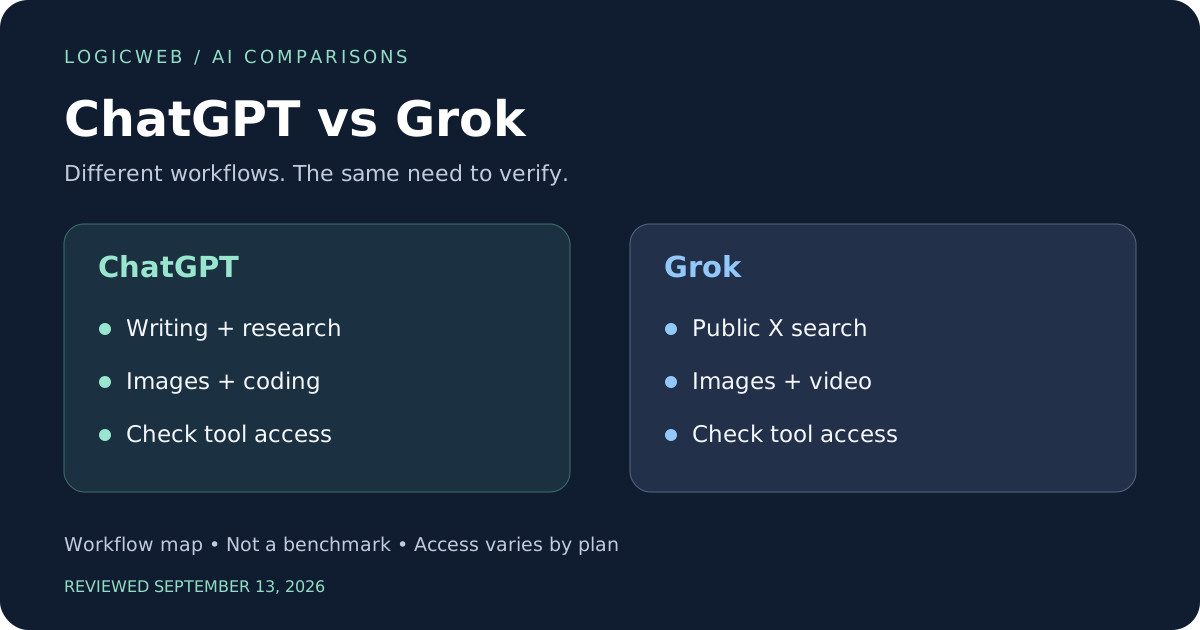
The official product pages establish that both products span writing, coding and imagery; Grok additionally advertises live web and X search and video generation. ChatGPT lists research, image and coding tools with plan-dependent access. The table is a capability map, not a benchmark. ChatGPT plan comparison; Grok product overview
| Task | ChatGPT | Grok | What matters |
|---|---|---|---|
| Research | Research tools; check sources | Web and public X search | Access to a source does not establish its truth |
| Writing | Drafting and revision | Drafting and revision | Compare against the same editorial brief |
| Photos and illustrations | Image generation | Imagine image generation | Inspect text, geometry and brand consistency |
| Video creation | Sora web/app discontinued | Advertised in Grok / Imagine | Separate video generation from scripting |
| Coding | Code assistance; Codex access varies | Code generation; Build access varies | Run the output before judging it |
| Monthly example | Plus: US$20 | SuperGrok: US$30 | Different bundles; verify checkout |
How this comparison was prepared
This is a source-based comparison reviewed on September 13, 2026. It does not claim hands-on testing of every service, publish synthetic benchmark scores or guarantee that any assistant is always correct. Official documentation supports capability statements; the recommendations are editorial judgments about workflow fit. The examples below are realistic, reproducible briefs, not customer case studies or measured outputs.
The comparison concerns the consumer assistant experience unless a separate developer tool is explicitly named. A model name, a chat subscription, an API and a third-party connector are different layers of a product. Access can vary with plan, region, account settings and rollout. Check the feature in your account before committing to a workflow that depends on it.
ChatGPT vs Grok pricing: compare the full workflow
For the monthly consumer examples used here, ChatGPT Plus is listed at US$20 and SuperGrok at US$30. Grok also lists SuperGrok Plus at US$100. This is not an exhaustive catalogue of business plans or regional offers. Read current checkout terms for currency, tax and eligibility. ChatGPT Plus details; Grok plans and pricing
The US$10 difference between the two example plans is US$120 over twelve months if the monthly prices remain unchanged. That arithmetic says nothing about value until you know what you actually finish. If a video feature replaces a separate service you already pay for, it may outweigh a higher chatbot bill. If you mostly revise web copy, the extra feature may be irrelevant.
Free access is useful for a first trial, but it may not expose the tools or volume you need. Paid access can still have limits. A chatbot subscription should not be treated as a hosting budget or an unlimited allowance for a customer-facing application. If you plan an integration, price the relevant developer product separately.
ChatGPT and Grok: detailed pros and cons
ChatGPT: advantages
- A practical fit for a mixed content workflow: evaluate the writing, image and file tools together rather than paying for isolated features you rarely use.
- Its broader tool access on paid tiers can suit a site owner moving between research and production. That is a convenience advantage, not evidence of superior answers.
- A free starting point makes a small evaluation possible before committing to a recurring subscription.
ChatGPT: limitations
- A subscription does not remove the need to check citations, calculations or code; a polished answer can still contain a material mistake.
- If your primary deliverable is generated video, the discontinued Sora consumer experience is a significant gap in this comparison.
- Different tools and models have different allowances. A successful short trial may not predict a full day of production work.
Grok: advantages
- Public X search makes Grok worth evaluating for questions about current discussions on that platform.
- Advertised image and video generation can reduce the number of tools involved in an early creative concept.
- For a team already following topics on X, examining the original discussion may be more useful than a generic web summary.
Grok: limitations
- Social conversation is a noisy source: repetition, jokes and speculation can look like confirmation when summarized.
- The illustrated paid comparison costs more for SuperGrok than ChatGPT Plus, although the bundles are not equivalent.
- Native media tools do not establish output quality or suitability for a specific brand; the same brief still needs review.
These advantages and limitations explain fit for the tasks in this guide. They do not claim that either product wins every writing, coding, research or creative assignment.
Real-life example: investigate a reported hosting outage
Illustrative scenario, not a measured test. Imagine a support manager sees customers discussing slow websites. The task is to build an evidence-based incident brief, not diagnose an entire hosting network from social posts. Supply a time window, affected service names and your own redacted observations. Ask for original links, timestamps and a separate list of unresolved claims.
Grok is a candidate when the relevant conversation is on X; use its search results to identify reports worth investigating. Use ChatGPT’s research tools to assemble a comparable brief from accessible sources. A missing post in one result is a retrieval limitation, not evidence that the incident did not happen.
Try this prompt
Find public reports about this service during this UTC time window. Separate official status updates, direct user observations and speculation. Link each source and state what remains unverified. Do not infer a root cause.
Judge the brief by whether another person can reconstruct the timeline. A useful result distinguishes the time a post was published from the time its author experienced a problem. A bad result counts reposts as independent incidents or treats a popular explanation as an official diagnosis. Check an authoritative status page and your own monitoring before posting a customer update.
Real-life example: design an image for a WordPress landing page
Illustrative scenario, not a measured test. A small business wants an original hero illustration showing secure file transfer. Use an invented company and a neutral visual brief so the comparison does not depend on copying a brand. Ask both image tools for the same subject, composition and empty area for a headline.
ChatGPT image generation and Grok Imagine are both candidates. This article does not present fabricated samples as outputs from either service. Make a small batch in each account and keep the original prompts so you can distinguish a one-off attractive result from a repeatable workflow.
Try this prompt
Create a clean editorial illustration of files moving between two servers. Dark navy background, teal highlights, no lettering, no logos. Leave the left third open for a headline. Avoid padlocks that obscure the servers.
Inspect the image at the size your visitors will see. Check ambiguous cables, inconsistent perspective and distracting details. Then add actual headline text in WordPress or your design tool, where it stays editable. The stronger result is the one that communicates the idea and survives cropping, not necessarily the one with the most decorative detail.
Real-life example: storyboard and produce a short promo video
Illustrative scenario, not a measured test. Suppose a creator needs a short visual concept for a fictional backup service. Break the assignment into scripting, shot planning, footage generation and final editing. These are separate deliverables; an excellent storyboard is not an exported video.
Grok advertises video generation through Imagine. OpenAI states that Sora’s web and app experiences ended on April 26, 2026, with API discontinuation scheduled for September 24, 2026. Do not buy ChatGPT on the assumption that an old Sora subscription benefit remains available. OpenAI: Sora discontinuation
Try this prompt
Write a three-shot storyboard for an eight-second concept about restoring a deleted file. No on-screen claims or brand names. Describe framing, motion and transitions, then produce a separate narration draft.
Use either assistant for the written brief and an available video tool for footage. Review continuity frame by frame, especially files or icons changing shape. Add final captions in an editor. A sensible comparison records how many attempts produce usable seconds; it does not compare a script from one product against a finished clip from another.
Real-life example: build a browser memory game
Illustrative scenario, not a measured test. A publisher wants a lightweight game to accompany an educational article. The assignment is a four-by-four card-matching game with a move counter, restart button and keyboard support. Start with a single HTML file and no accounts, payments or external scripts.
Both assistants can be evaluated as coding helpers. Ask for the same rules and give each the same bug report after the first attempt. Do not treat different preview environments as a code-quality result: open both exported files in the same browser.
Try this prompt
Build a single-file HTML memory game with eight pairs, keyboard-operable cards, a visible focus state, move counter and restart. Prevent a third card from opening while two unmatched cards are being compared. Explain how to test it.
The third-card rule is a useful edge case. Also restart while a mismatch timer is running, test repeated clicks and complete the game using only a keyboard. Record working requirements and repair attempts. A beautiful board that accepts invalid moves loses to a simpler board that behaves correctly. This creates a concrete comparison without inventing benchmark scores.
Real-life example: prototype a support triage app
Illustrative scenario, not a measured test. A website operator needs a mock dashboard that groups fictional support requests by category. Supply synthetic tickets covering billing, DNS, email and performance. Define the categories yourself and ask for ambiguous tickets to be flagged for review.
Use both tools to propose a small interface and classification rules. Keep the first version local, with explicit sample data. A chatbot prototype should not silently become an integration with a live ticketing system.
Try this prompt
Create a local prototype that filters these fictional tickets by category and urgency. Show the classification rationale. Mark uncertain categories for human review. Do not send any data to an external service.
Test a ticket mentioning both a failed payment and a suspended mailbox. The tool should not pretend a single keyword resolves the issue. Compare how easily you can adjust rules and understand the result. A useful prototype is transparent about uncertainty and has a clear path to real authentication, permissions and monitoring before deployment.
Where to see documented product examples
Explore Grok’s official media and product overview for provider-published examples. These are vendor demonstrations or documentation, not independent performance tests. They show a workflow to investigate; they do not establish success rates on your own material.
The comparison graphics accompanying this article are original editorial illustrations. They are not screenshots, model-generated samples or measured rankings. The prompts in the examples are provided so you can build your own evidence with the account and features you actually have.
How to run a fair comparison on your own work
Choose three tasks from your own week and define success before opening either assistant. One should have a verifiable answer, one should involve revision and one should produce something you can open or run. Give both the same input files, the same deadline and comparable paid or free access. Record the date, selected model, tools enabled and any important account limitation.
| Measure | What to record | Why it matters |
|---|---|---|
| Correctness | Claims supported; calculations and rules checked | Fluent wording can hide factual errors |
| Completion | Requirements satisfied in the exported result | A preview alone may omit important behavior |
| Revision effort | Minutes spent fixing and verifying | The first answer is not the final deliverable |
| Source quality | Original references and claim-level support | Many citations can still be irrelevant |
| Practical cost | Subscription, extras and unusable attempts | Advertised price is only part of production cost |
Repeat a difficult task at least once if the first result would determine a purchase. Keep unsuccessful outputs in your notes instead of selecting only the nicest example. Do not compare a powerful paid tool in one service with an inaccessible feature on the other’s free account and present the result as a general verdict. Where access differs, report that difference as part of the result.
For writing, ask another person to review anonymized drafts. For code, use explicit acceptance checks and open the exported files. For imagery, compare both initial output and a requested correction. For research, inspect whether every important claim follows from the cited material. These checks make the evaluation useful even when the underlying products change.
Privacy and business data: compare the exact account
Use fictional or redacted information for the first trial. Before introducing business data, identify the exact account type and examine its current retention, training, sharing and connector controls. A consumer subscription and an organization-managed account should not be assumed to have identical arrangements. Check where generated files and shared links can be accessed.
OpenAI documents an option to disable use of new conversations for model improvement through ChatGPT’s data controls. That setting is not a universal promise about every connected service or every form of retention. Review the other provider’s applicable settings and terms separately. ChatGPT Data Controls FAQ
For a practical evaluation, replace customer names, email addresses, access tokens and billing records with sample data. A helpful assistant can draft a checklist without receiving your live credentials. If an app needs an external integration, document what it reads and writes before connecting a production account. Human review should be part of the workflow whenever an error could affect a customer.
From AI prototype to a working WordPress site
For readers building a WordPress site, the assistant is one part of the production process. A generated game or calculator may need its own JavaScript, stylesheet or plugin wrapper. An interactive preview hosted by an AI provider does not automatically become a portable WordPress component. Decide whether the final result should be embedded, exported as static files or rebuilt against your own backend.
Keep server credentials and API secrets out of browser code. Use a test environment to check forms, loading behavior and mobile layouts before making a tool public. Confirm how data is saved and recovered, and who maintains the application when a dependency changes. A small static widget and a multi-user app have different hosting and operational needs.
When choosing infrastructure, start with the application’s actual runtime, storage and traffic requirements. Visit LogicWeb to discuss hosting needs once those requirements are clear. This comparison makes no unverified claim about a particular LogicWeb plan, price or included feature.
Which should you choose: ChatGPT or Grok?
For a site owner whose day alternates between documents, research, code and images, begin by testing ChatGPT against that mixed workload. For someone whose central tasks involve public X conversations and generated video concepts, put Grok on the shortlist immediately. Keep both only if their distinct contributions justify the extra cost and context switching.
There is no promise of perfect accuracy, permanent feature availability or better results from a brand name alone. Keep the prompts, results and review notes from your trial. Revisit the decision when a feature you rely on changes, rather than switching merely because a new model name appears.
ChatGPT vs Grok: frequently asked questions
Is Grok more accurate than ChatGPT?
This guide establishes no universal accuracy winner. Test both against the same questions with known answers, and check source support separately from writing quality.
Can ChatGPT and Grok both generate images?
Both advertise image generation. Availability and allowances depend on the current product and plan; an advertised feature does not guarantee a usable result for every brief.
Can ChatGPT still make Sora videos?
OpenAI says the Sora web and app experiences were discontinued on April 26, 2026. Its API shutdown is scheduled for September 24, 2026. Scripting a video in ChatGPT is a different task.
Is a Grok subscription the same as an X subscription?
Do not assume the entitlements are identical. This article compares the Grok plans shown on the official Grok pricing page; check the exact product and account at checkout.
Sources and update notes
Official sources checked September 13, 2026. Recheck pricing, availability and account conditions before purchasing or republishing. Source pages are living documents and may later describe different features.
- ChatGPT plan comparison
- ChatGPT Plus details
- OpenAI: Sora discontinuation
- Grok product overview
- Grok plans and pricing
- ChatGPT Data Controls FAQ
Editorial scope: a documented-capability comparison with original practical scenarios. No undisclosed numerical scoring or claimed hands-on benchmark results are used.