
cPanel vs CWP is the comparison people run when they still want a hosting panel — accounts, mail, DNS, SSL, PHP, a file manager — and they do not want a WebPros invoice. Control Web Panel, formerly CentOS Web Panel, publishes a free core and a cheap Pro upgrade. cPanel publishes an account meter. Both will put a website on AlmaLinux. Only one matches the muscle memory of a typical inbound migration.
CWP is aimed at VPS and dedicated admins, not at shared hosting you buy from someone else. The marketing site still lists a 1 GB RAM floor and talks about CWP Secure Kernel. The installer people actually run is on the EL family: AlmaLinux 8 and 9 (recommended), Rocky Linux, CloudLinux. CentOS 7 is a museum. Close any tutorial that still says otherwise.
What CWP is in 2026
cPanel Admin Cloud is $35.99 for five accounts. CWP’s core is $0. That sentence is true and incomplete. You still pay for the guest, the addresses, the backups, and the hour you will spend when PHP-FPM and Nginx disagree. LogicWeb v.box is the machine. CWP is optional software you put on it. Shared cPanel is the product where we already chose the panel.
| cPanel | CWP | |
|---|---|---|
| License | Paid account tiers from $29.99 | Free core; Pro $1.49/mo or $11.99/yr |
| Pro + support | WebPros + the host | $12.99/mo if you buy that SKU |
| OS | Supported EL and Ubuntu list | EL family (Alma, Rocky, CloudLinux) |
| Windows | No | No |
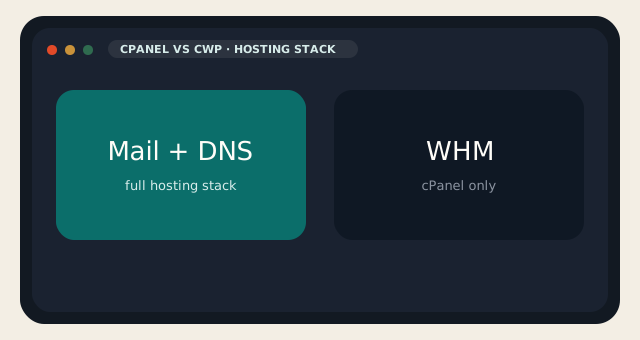
| Mail / DNS | Yes | Yes — full hosting stack |
| Web | Apache; LiteSpeed common at hosts | Apache / Nginx options in the panel |
| WHM | Yes | Admin UI; not WHM |
| Our migrations | Free cPanel-to-cPanel on shared/reseller | You move it, or you pay for a project |
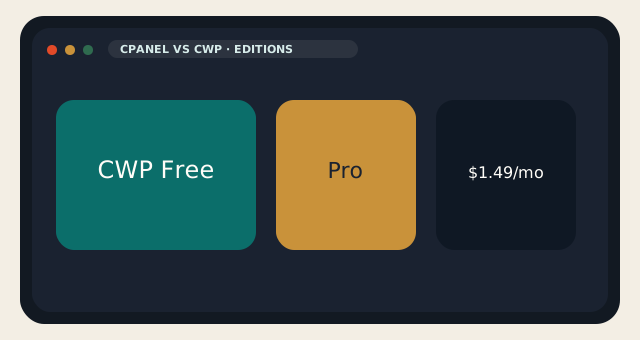
CWP Pro on the vendor’s cart is $1.49 per month or $11.99 per year. Pro plus support is $12.99 per month. Partner licenses are $0.99 with a ten-license minimum. Pro is the faster patch cadence and extra modules, not a secret $60 cPanel clone. Treat it as optional paid software.
Features, Pro pricing, EL family
Free CWP includes domains, DNS, mail, SSL, a file manager, PHP versions, databases, CSF-shaped firewall habits, and resource graphs. That is what people mean by “a panel.” Pro unlocks extra modules and the update cadence people actually wanted when they said free.
cPanel vs CWP on WordPress is uneventful until something breaks. Both will run PHP-FPM and a certificate. cPanel’s WP Toolkit is the productized version: staging, cloning, bulk updates. CWP will install WordPress. If staging is the job, WordPress hosting on our cPanel nodes is the boring answer. If the job is one site you will SSH, CWP is a UI over the same guest.
Mail is how a free panel starts to feel expensive. Reverse DNS, SPF, DKIM, DMARC, and the neighborhood do not care which logo drew the mailbox. A free panel on a bad prefix is still a blocklist listing. Put mail on a prefix you can explain. Confirm the path on an IP lookup before you blame CWP.
CWP — strengths and limits
- $0 core, $1.49 Pro, full hosting stack, native on Alma/Rocky/CloudLinux.
- Denser UI than Hestia; lots of toggles; you are the support organization.
- Not WHM; not a panel we will run on shared.
cPanel — strengths and limits
- WHM, pack copy, Imunify on our shared, a UI clients already know.
- The meter, Linux only, a commercial lease.
When to use which
Use cPanel when the humans already know it, when you sell accounts, or when you wanted us to hold the license. Use CWP when you own the VPS, you want mail and DNS without WebPros, and you can restore from a snapshot. Do not drop CWP onto a production shop the Friday a cPanel invoice arrived. Do not use it on shared. Shared here is not bring-your-own-panel.
cPanel vs CWP is the wrong title if LiteSpeed cache is the actual requirement — that is CyberPanel. If you wanted Docker apps, that is 1Panel. If you wanted the smallest GPL panel that still does mail, look at Hestia before you look at CWP’s module list. The free Linux panel roundup is the map. This page is the CWP street.
Give the guest 2 GB if you can. The 1 GB floor is a floor. Take a snapshot, install once, and keep the panel you chose. Two panels on one guest is how Nginx and Apache share a port until neither works.
cPanel vs CWP on mail is where free starts to cost time. If you send from the VPS, set PTR to match HELO, keep volumes modest, and watch the blocklists. If you send a lot, a dedicated mail node or a provider who already warms prefixes will beat a clever panel. CWP will draw the mailbox. It will not wash a neighborhood.
For agencies, cPanel vs CWP is usually decided by the client, not the admin. Clients who arrived from Bluehost, SiteGround, or us already know cPanel. Teaching them CWP to save $36 a month is a training invoice. Teaching yourself CWP on a VPS you own is reasonable.
Updates matter more than the feature list. Free CWP that you never patch is worse than cPanel you never log into, because we patch the node. If you run CWP, turn on Pro if you needed the cadence, or put a calendar reminder next to the snapshot job. Unpatched panels are how old PHP-CGI bugs return.
cPanel vs CWP should not be a Friday experiment on a live shop. Clone the guest, install, move one site, send a test message, then schedule the rest. If that sounds like too much work, you wanted us to keep the cPanel license.
Backups are the other split. On shared, we already run the cPanel account dump you restore from. CWP will dump files and databases if you turn that job on and send the archive off the guest. Turn it on. A $0 panel with last week’s files only on the same disk is not a backup. It is a copy waiting for the same failure.
PHP handlers deserve a sentence. CWP will let you pick versions per domain. So will cPanel. The difference is who notices when 8.1 goes EOL: we patch the shared node; on CWP that calendar is yours. Pin versions on purpose, and do not leave PHP-CGI next to PHP-FPM “just in case.”
Reader discussion
Join the conversation.
Questions, corrections, and useful context are welcome.