
An IPv4 address is just a 32-bit number, so why does a block of them have a monthly price in 2026? Because the number of possible IPv4 addresses is fixed, the globally routable supply is constrained, and real networks still need addresses for servers, VPNs, mail systems, customers, proxies, infrastructure, and compatibility with an internet that has not completed the move to IPv6.
The shortage is not new. Regional registries exhausted their pools of freely available general-purpose IPv4 years ago. What changed afterward was the market around existing allocations: organizations transfer space, brokers match buyers and sellers, and leasing lets networks use prefixes without buying the underlying registration rights.
A /24 is small enough to understand
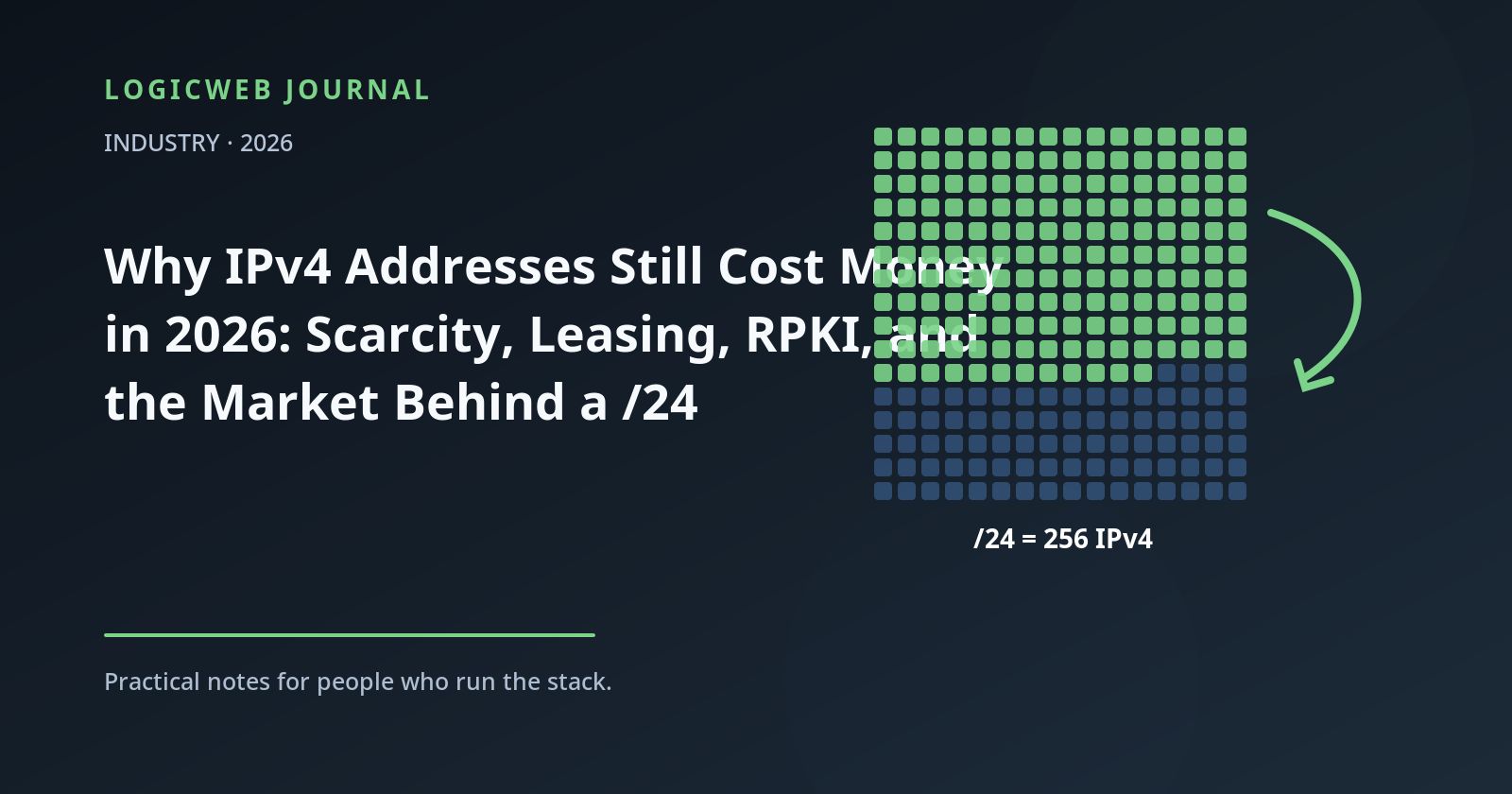
A /24 contains 256 IPv4 addresses. It is also a common unit in internet routing because more-specific IPv4 announcements than /24 are often filtered by operators. That makes a clean, routable /24 a practical building block for organizations that need their own address pool or want to announce space through an ASN.
What you are actually paying for
- Scarce address rights: there is no new pool of IPv4 waiting to be created.
- Routability: the space must be properly registered and usable in BGP.
- Administration: LOA, IRR objects, RPKI/ROA, WHOIS/SWIP, reverse DNS, and abuse handling take work.
- Reputation: addresses with abusive history can be operationally expensive even if they are technically routable.
- Geolocation maintenance: databases do not update instantly or uniformly when a prefix changes use or region.
Buying vs leasing IPv4
| Model | Advantages | Tradeoffs |
|---|---|---|
| Transfer/purchase | Long-term control of the resource after registry process | High upfront capital, transfer process, ongoing registry obligations |
| Lease | Lower upfront cost, flexible term, easier scaling/rotation | Recurring cost, depends on lessor processes and continued authorization |
| Provider-assigned IPs | Simplest for ordinary hosting | Usually tied to the provider/service; limited portability |
Leasing makes sense when the requirement is operational rather than investment-driven. A network may need a /24 for a project, customer pool, VPN fleet, mail infrastructure, or geographic deployment without wanting to spend heavily on a permanent transfer.
The LOA is the bridge to routing
A Letter of Authorization tells an upstream or hosting provider that the resource holder permits a particular organization or ASN to announce the prefix. It is administrative evidence, not a cryptographic control. That is why modern routing practice pairs authorization paperwork with routing database objects and RPKI where possible.
RPKI makes origin authorization machine-verifiable
A ROA states which ASN is authorized to originate a prefix and can be checked by networks performing route-origin validation. For leased space, this matters because the organization using the addresses may not be the registry resource holder. The lessor needs a process to create or update the ROA for the correct origin.
Why “clean IPs” is not a permanent property
IP reputation is historical and contextual. Spam traps, abuse reports, credential attacks, bot traffic, and previous customers can all influence how an address is treated by third-party systems. But reputation also changes after reassignment. No responsible provider can promise that every independent database on the internet will forever classify an address identically.
The better questions are operational: Does the provider review abuse history? Is reverse DNS available? Can geolocation be corrected? Is there an abuse desk? Can the prefix be rotated when there is a legitimate reputation problem?
IPv6 did not make IPv4 irrelevant
IPv6 solves the address-space problem on a scale IPv4 cannot match, and new systems should support it. But dual-stack reality means many services still need IPv4 reachability. Some networks, applications, allowlists, customers, and commercial systems remain IPv4-dependent. As long as that compatibility requirement remains, scarce IPv4 addresses retain utility.
What a good IPv4 lease should include
- Clear CIDR size and monthly price.
- Authorization to announce the prefix, usually via LOA.
- IRR and RPKI/ROA support where applicable.
- WHOIS/SWIP or equivalent registration updates when needed.
- Reverse DNS delegation or PTR management.
- Geolocation update process and realistic timing expectations.
- Abuse contacts and an acceptable-use policy that protects the reputation of the pool.
LogicWeb currently lists IPv4 leasing from a /24 upward and includes LOA, geolocation changes, IRR, RPKI/ROA support, and routing options. See the live IP leasing page for current inventory and pricing rather than relying on a static number in an article.
FAQ
How many IPv4 addresses are in a /24?
A /24 contains 256 total IPv4 addresses.
Why lease IPv4 instead of buying it?
Leasing reduces upfront capital and can be faster or more flexible for temporary, scaling, or project-based requirements.
Does IPv6 eliminate the need for IPv4?
Not yet. IPv6 adoption is substantial, but many networks and applications still require IPv4 connectivity, so dual-stack infrastructure remains common.
Reader discussion
Join the conversation.
Questions, corrections, and useful context are welcome.