
Most “top agentic tools” lists in 2026 still sell a chatbot with a calendar. That is not an agent. An agent plans, uses tools, and keeps going when a step fails. The top agentic tools that actually shipped this year live in three aisles: coding agents that touch a repository, cowork agents that sit on a folder of files, and workflow agents you host yourself.
I am writing this on 1 September 2026. Claude Code, OpenAI Codex, Grok Build, Cursor, GitHub Copilot, Gemini CLI, n8n, and Copilot Studio are the names operators keep. AutoGPT clones and “one more multi-agent framework” are homework. If you wanted a demo, you already had one in 2024.
Coding agents
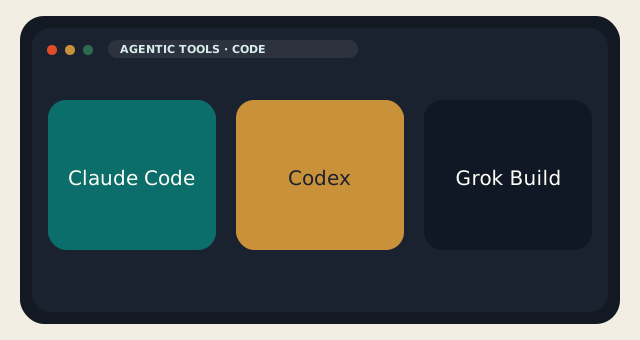
Claude Code is the coding agent most serious shops moved to this year. It lives in the terminal, reads the tree, edits files, runs tests, and talks git. Anthropic’s Cowork layer sits next to it for people who are not in a shell all day. You pay Claude Pro at $20 a month, or Max at $100 / $200 if you actually burn the quota. Claude Code is why people pay. The chat tab is not.
OpenAI’s Codex is the other terminal agent. It ships on ChatGPT tiers, including Free in a limited way, which is how a lot of juniors met it. GPT-5.6 Sol is the current flagship brain on the ChatGPT side. Codex is fast on smaller diffs. Claude still wins more of the ugly refactors. If your team already lives in ChatGPT, Codex is the default. If your team already lives in Claude, do not dual-wield “for coverage.”
Grok Build is xAI’s app-shaped agent: prompt to a running preview, not a patch in a repo you already had. SuperGrok is $30 a month with Grok 4.6; SuperGrok Plus is $100. The API for Grok 4.6 is $2 input / $6 output per million tokens, which is the cheap seat when you are looping. Grok Build is the right agentic tool when you did not have a codebase yet. It is the wrong one when you needed a careful PR on a ten-year PHP app.
Cursor remains the AI-native IDE: fork of VS Code, agent mode, whatever model you point it at. GitHub Copilot is still the corporate default because procurement already said yes. Gemini CLI is the free-ish Google door. Windsurf and Devin still exist; they are not the list you should start with. OpenCode and Cline matter if you wanted the agent without a single vendor’s IDE.
| Tool | Desk | Usual plan | Use it when |
|---|---|---|---|
| Claude Code | Terminal + repo | Claude Pro $20 / Max $100–$200 | Hard refactors, long context |
| Codex | Terminal + ChatGPT | Free limited; Plus $20 | Fast diffs, ChatGPT shops |
| Grok Build | Prompt → app | SuperGrok $30 / Plus $100 | New apps, previews |
| Cursor | IDE | Cursor Pro (separate) | You live in the editor |
| GitHub Copilot | IDE + GitHub | Copilot Business | The org already bought it |
| Gemini CLI | Terminal | Google account | Free frontier experiments |
Those six are the coding half of the top agentic tools for 2026. Everything else in this aisle is a wrapper. Wrappers rot when the model API moves. Buy the agent that will still open the repo in March.
Cowork, chat agents, and workflows
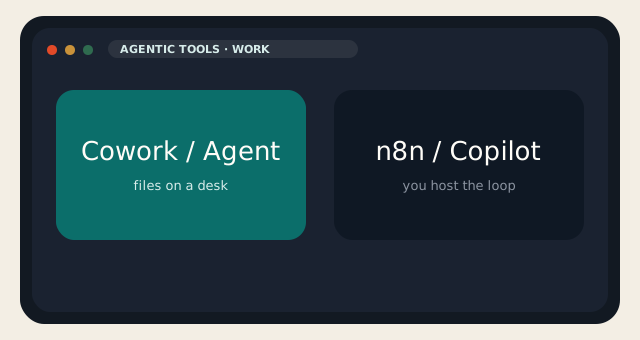
Claude Cowork is the non-developer half of Anthropic’s bet: give the model a workspace of documents, let it write, file, and return artifacts. ChatGPT’s agent / scheduled “work” features do the same job with a more consumer surface — voice, images, memory, and the GPT store. Grok’s scheduled automations and Grok Bot are strongest when the input is live X plus the web. That is a real split among agentic tools, not a branding exercise.
Below the model labs sit the workflow products. n8n is the one you can actually self-host on a KVM VPS. CrewAI and LangGraph are for teams writing Python, not for a marketing intern. Microsoft Copilot Studio is for tenants that already pay for M365. Gumloop and Zapier Agents are the no-code drawers. They are agentic tools in the brochure sense. They are zaps with a better prompt box in the operational sense.
What is not on this list on purpose
- AutoGPT-class GitHub toys from 2023. They taught the demo. They are not ops.
- A dozen “multi-agent orchestration” startups with the same LangGraph core.
- Browser-use toys that book a flight once and then fail on the 2FA page.
- Anything that wants production AWS keys in a chat window.
If a vendor cannot tell you where the loop runs, who holds the logs, and what happens when the tool call 500s, it is not one of the top agentic tools. It is a landing page.
What still needs a host
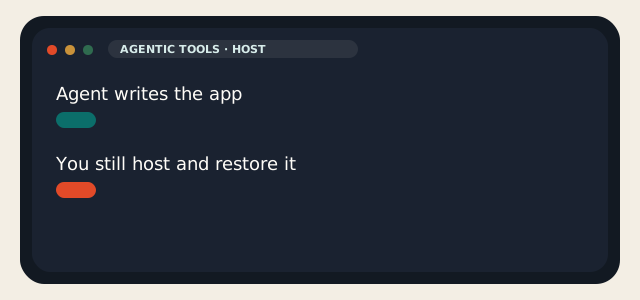
Every one of these agentic tools eventually emits a site, a worker, or a webhook. That artifact still needs DNS, TLS, a PHP or Node runtime, and a backup you have restored. Grok Build will preview. Claude Code will commit. Neither of them is LiteSpeed, and neither of them is Imunify. If the thing you built is WordPress, it belongs on WordPress hosting with WP Toolkit, not on a laptop process you will close.
Self-hosted n8n, Open WebUI, or an MCP server is a VPS product. Snapshot first. Do not put the agent’s secrets in the web root. Do not give it sendmail on a shared node. Our cPanel stack is for sites and mail. The agent that deploys into it should be a deploy, not root.
The honest buying guide for agentic tools in 2026: pay for one coding agent (Claude Code or Codex, plus Cursor if you want the GUI), use Grok Build or Sitejet when you are starting from zero, and host the result on a machine with a restore. Two subscriptions beat seven. A restore beats a transcript of the session that built the broken box.
People ask which of the top agentic tools will “replace developers.” None of them. They replace the afternoon you would have spent wiring a form to a table. They do not replace the person who notices the form stored card numbers in wp_options. That person still needs a host who answers the phone.
If you only remember one thing from this list of agentic tools: the model is the cheap part. The loop, the logs, and the restore are the product. Pick the agent that writes into a tree you already know how to back up.

[…] site-building agent still needs DNS, TLS, backups and a host after the preview works. LogicWeb’s guide to agentic tools in 2026 covers the execution layer, while the local AI on a VPS guide covers the opposite trade-off: […]