
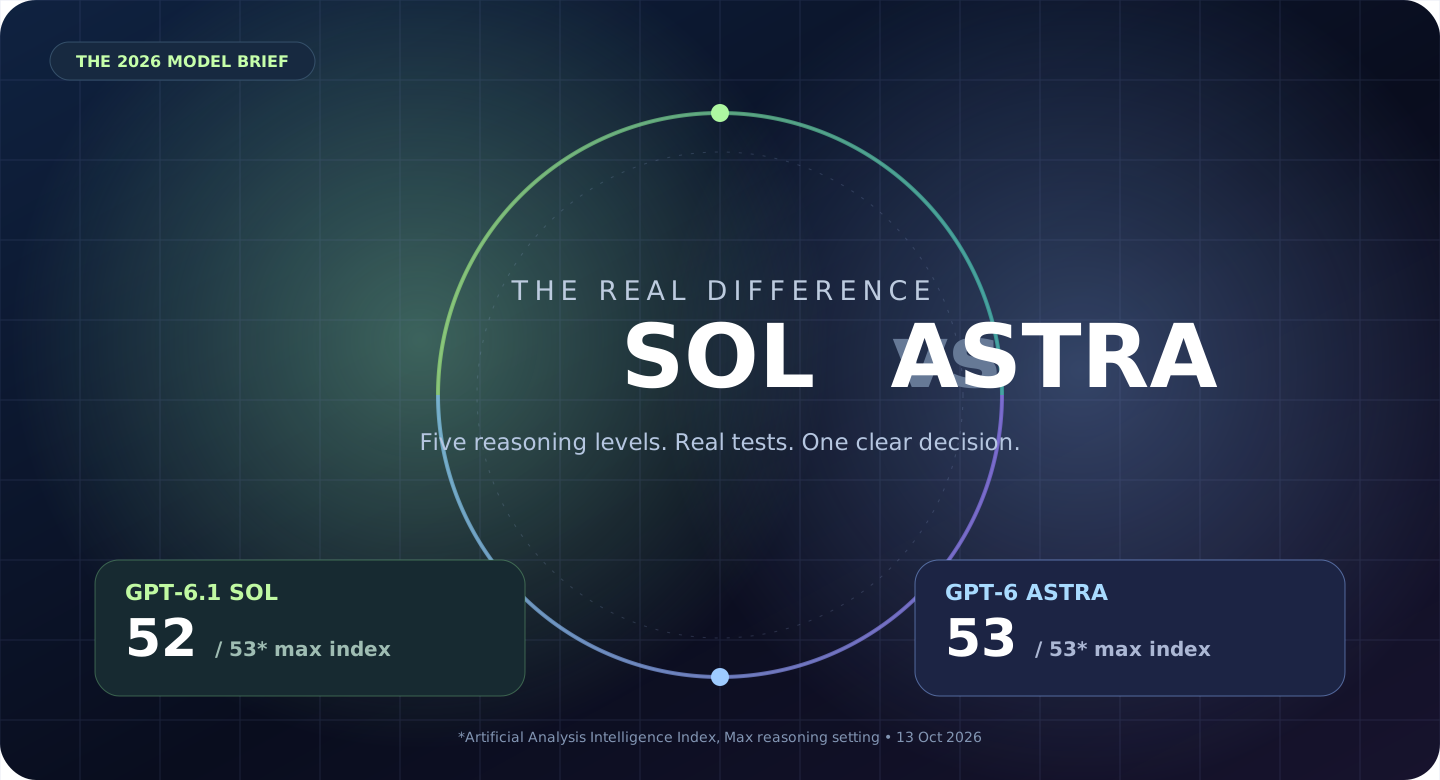
GPT-6.1 Sol vs GPT-6 Astra: All Five Levels, Prices & Real-World Tests
GPT-6 Astra wins on peak intelligence. GPT-6.1 Sol gets surprisingly close at a fraction of the API cost. Here is the full five-level picture—plus real code and app-build comparisons, without the hype.
Benchmark snapshot: Artificial Analysis Intelligence Index v4.3.2 • All prices USD • Independent examples attributed below
Max Intelligence Index
Sol / Astra
Astra-to-Sol standard input/output API price ratio
Advertised context-window tokens for both API models
API reasoning levels compared, Low through Max
Every reasoning level, side by side
These are API reasoning-effort settings—Low, Medium, High, Extra High (xhigh) and Max—not five separate model releases. Higher effort can increase quality, latency and usage. Sol trails Astra by only 1–4 Intelligence Index points at the same setting.
Intelligence Index by effort
| Effort | Sol Index | Astra Index | Sol cost/task | Astra cost/task | Sol speed | Astra speed |
|---|---|---|---|---|---|---|
| Low | 42 | 46 | $0.13 | $0.82 | 51 t/s | 54 t/s |
| Medium | 48 | 50 | $0.21 | $1.54 | 55 t/s | 53 t/s |
| High | 50 | 51 | $0.32 | $1.73 | 58 t/s | 54 t/s |
| Extra High | 51 | 52 | $0.39 | $2.31 | 59 t/s | 57 t/s |
| Max | 52 | 53 | $0.72 | $3.26 | 62 t/s | 61 t/s |
Cost/task is Artificial Analysis’s weighted benchmark task cost, not a fixed price for your prompt. Speed means generated output tokens per second after
The price gap is bigger than the intelligence gap
Both models use the same quoted base API rates at every effort setting: Sol $2 input / $10 output and Astra $10 input / $50 output per million tokens. Cached input is $0.10 versus $1.00 respectively. Actual task spend still depends on token use, tools and retries.
What benchmark tasks actually cost
Choose Sol for the default route
Iterative refactors, test writing, document extraction, scheduled business reports, support agents and repeatable code workflows where unit economics matter.
Bring in Astra for the hardest route
Research-grade analysis, difficult terminal-agent tasks, ambiguous deliverables, and final review where even a modest improvement in correctness is valuable.
The commonly quoted “5× cheaper” refers to standard uncached input and output token rates, not a guaranteed 5× reduction in every completed job. Official prices: OpenAI’s GPT-6.1 Sol release.
Terminal coding: Astra still has the edge
On the independently tracked Terminal-Bench 4.0, Astra’s Max score is 59.1% against Sol’s 56.1%. However, the race is not monotonic: Astra’s Extra High result (59.6%) slightly exceeds its Max result in this snapshot, so effort alone is not a guarantee of a better measured outcome.
Terminal-Bench 4.0 pass rate
Test your own repo in two API calls
This small runnable starter example uses the same repo task with each model. It illustrates the correct API interface; it is not a claimed head-to-head result. Set OPENAI_API_KEY, install the OpenAI Python SDK, and supply a representative failing test or patch context.
from openai import OpenAI

client = OpenAI()
brief = (
    "Review this Python function for edge cases and return "
    "a minimal unified diff plus pytest tests. "
    "Function: def free_windows(start, end, busy): ... "
    "Handle overlaps, clipping and touching intervals."
)

for model in ("gpt-6.1-sol", "gpt-6-astra"):
    response = client.responses.create(
        model=model,
        reasoning={"effort": "high"},
        input=brief,
    )
    print(f"\n--- {model} ---\n{response.output_text}")
For a credible evaluation, run patches in isolated copies of the same repository and report tests passed, regressions, human fixes, elapsed time and full usage. The example’s code and method are editorial illustrations based on the OpenAI Responses API guide, not a published experiment.
Real app and coding examples you can inspect
These are published third-party tests with described prompts and observed outputs, not synthetic testimonials. We distinguish what the authors actually tested from what broader performance claims would require.
Calendar-gap function
Both models generated a free_windows() implementation. Oasis reports each passed 1,007 independent checks covering overlaps, clipping, boundary contact and full coverage.
Rocket-launch mission control
Both created one-page animated rocket dashboards from an open brief. The Sol build showed booster separation; the Astra build offered a zoom control and richer flight visuals.
Seaside fairground
Each model built a moving Ferris wheel and carousel. In this single-run judged build-off, Sol handled canopy direction and a water reflection better, despite its own remaining errors.
Eight-second explainer
Both models wrote scripts that rendered a valid 192-frame, 1280×720 MP4. The reviewers preferred Astra’s final completion state and timing against the brief.
Study limitations: Oasis used four first responses at High effort with no browsing/tools. BitsMinds used one attempt per build, non-blind subjective judging, and compared models run on different dates/effort ceilings. Neither study establishes a general leaderboard of app-building quality.
Important: ChatGPT’s levels are different
API benchmark chart: The five settings in this article are low, medium, high, xhigh and max for each of the two named API models. OpenAI reasoning-effort documentation explains that these settings affect token usage and performance.
ChatGPT model picker: Instant, Medium, High and Extra High use GPT-6 Sol for eligible paid users, while Pro uses GPT-6 Pro powered by Astra. Free/Go and workspace availability differ. Do not assume selecting “Extra High” in ChatGPT gives you the same API setup—or automatically switches to GPT-6.1 Sol. Official ChatGPT model guide.
The buying decision in one sentence
Use GPT-6.1 Sol first and only pay for GPT-6 Astra when your own acceptance tests show a meaningful improvement. Astra holds the peak benchmark crown, but Sol’s quality-to-cost ratio is the more consequential result for most repeatable work.
Frequently asked questions
Is GPT-6.1 Sol better than GPT-6 Astra?
Not on the peak Intelligence Index: at Max, Astra leads 53 to 52. For cost-sensitive workloads, Sol is often the stronger starting choice.
Which one is better for programming?
Astra leads on Terminal-Bench 4.0 at Max (59.1% versus 56.1%). But in a published calendar-function test, both passed 1,007 cases; judge your own repo tasks before paying more.
Does Max thinking always make a model better?
No. Benchmark outcomes vary by task and run. More reasoning can cost more and take longer, and the published Extra High Astra terminal score slightly exceeds its Max result.
Are Sol and Astra available in ChatGPT?
Astra powers the GPT-6 Pro option where available. ChatGPT’s other GPT-6 thinking levels use GPT-6 Sol; the GPT-6.1 Sol model in these API charts should not be conflated with the ChatGPT selector.
Sources and disclosure
Benchmarks and weighted task costs: Artificial Analysis release comparison (accessed Oct 13, 2026). Rates and positioning: OpenAI GPT-6.1 Sol. ChatGPT access: OpenAI Help Center. Hands-on examples: Oasis, Oct 2, 2026; BitsMinds, Sep 30, 2026. The illustrations, chart styling and editorial synthesis are original; no independent model runs were conducted for this post.