
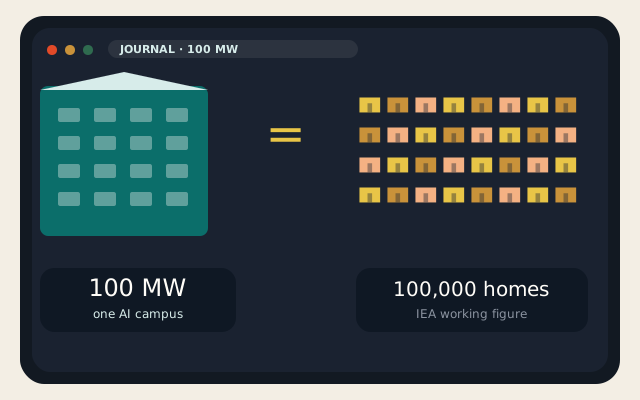
AI data centers are not a row of web servers. A typical hyperscale training hall, in the International Energy Agency’s working figure, draws about 100 megawatts — the same conversation as 100,000 households. Bloom Energy’s January 2026 note put U.S. data-center demand on a path from about 80 GW in 2025 toward 150 GW in 2028. The IEA still has global data-center electricity more than doubling toward roughly 945 TWh by 2030. Those numbers mix AI data centers with ordinary cloud halls. They are still the right scale. They are not a $5 cPanel account.
Today is 1 September 2026. Elon Musk told a G20 innovation meeting in Chapel Hill that chip production is compounding around 40–50 percent a year while electricity supply lags at 10–20. Whether you like the messenger, operators already know the mismatch: interconnect queues, substations, and generation, not GPUs on a purchase order. AI data centers follow the power. Counties follow the tax board. Households follow the rate filing.
On this page
A 100 MW campus uses as much power as 100,000 homes
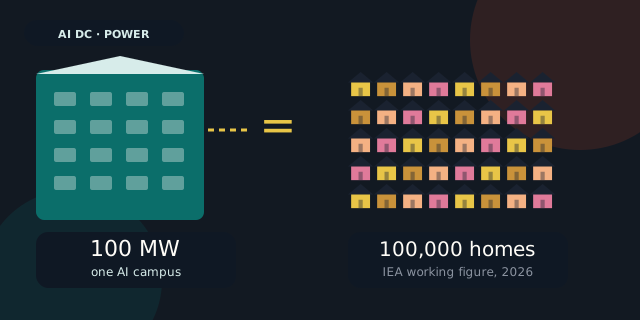
Traditional colocation sold kilowatts per cabinet. AI data centers sell tens to hundreds of megawatts, with rack densities that make an air-cooled 5–10 kW web cabinet look like furniture. Power availability now sets the construction calendar more than capital. If the utility cannot interconnect, the campus is a press release. Behind-the-meter gas, on-site generation, and “we brought our own plant” deals exist because the queue does not. That is a real upside for a region that can actually build generation. It is a real downside for a region that promised the campus before the substation.
LogicWeb’s data center story is the other scale: colocation and the metal we already run, plus KVM VPS in six cities and dedicated boxes with IPMI. We are not pouring a 100 MW training cluster. When a customer asks whether AI data centers mean their WordPress site is now a climate event, the honest answer is no. Their site is a few hundred megabytes and a PHP worker. AI data centers are a different industry that happens to use the same word “server.”
| Hyperscale AI hall | A normal host (us) | |
|---|---|---|
| Power | 100 MW class and up | A node, a cage, a chassis |
| Job | Train and serve models | Sites, mail, VPS, IPv4 |
| Constraint | Interconnect and generation | Abuse, backups, humans |
| Water | On-site cooling plus ~10× at the plant | Ordinary HVAC |
| Your $5 site | Irrelevant load | The actual product |
The upside on power: load that can justify new generation, a tax base, construction payroll, and a reason to rebuild a substation that was going to fail anyway. The downside: load that shows up faster than plants, fossil peaker deals sold as “AI-ready,” and residential rate cases where someone has to pay for the wires. AI data centers do not automatically raise your electric bill. A tariff that socializes their interconnection might.
Most of the water is used at the power plant, not the cooling tower
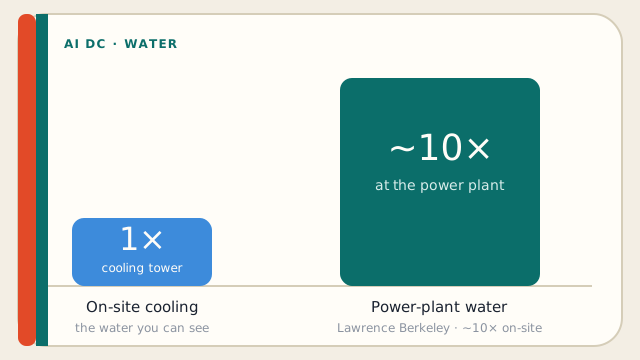
Cooling is what you can photograph. Large halls that still use evaporative systems can pull on the order of millions of gallons a day — figures in the five-million-gallon-a-day neighborhood get cited for the biggest sites, comparable to a small town. U.S. data-center water use was estimated around 17 billion gallons in 2023, with projections toward about 73 billion by 2028 if the build continues on that path. Direct use is still the smaller story. Lawrence Berkeley and follow-on work have been blunt: water consumed to generate the electricity can dwarf the on-site cooling, on the order of ten times in some U.S. accounting. AI data centers in drought counties get the pitchforks. Thermal power plants get the quieter, larger withdrawal.
Closed-loop, air, and immersion cooling exist and cut on-site freshwater. They do not delete the power-plant water. Siting in a wet, cool climate with a clean grid cuts both numbers. Siting on an aquifer a farm already uses is how you end up in the national press. A January 2026 Xylem-linked note argued that by mid-century, data centers themselves might be a small slice of AI’s extra water, with chips and generation taking most of it. If that holds, yelling only at the fence around AI data centers misses the fab and the plant.
What to ask before a campus is approved
- On-site evaporative cooling, or closed loop / air / immersion?
- Which aquifer, which river, which reuse plant — named, not “sustainable.”
- Indirect water: will the operator disclose the power-plant gallons, not just the cooling tower?
- In a drought, who gets curtailed first: the farm, the town, or the campus?
Construction jobs are real. So is the rate case on your bill.
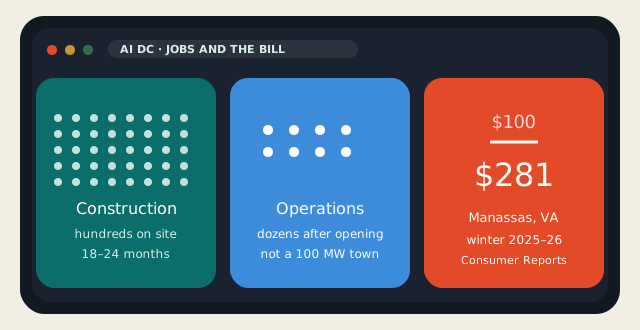
Jobs: construction is real, operations are fewer than the ribbon-cutting implies. A 100 MW hall does not employ a 100 MW town. Tax abatements that last longer than the construction payroll are how counties get played. Ask for the PILOT schedule. Ask who pays to extend the water main. AI data centers can be a good deal for a county that prices the interconnect, the water, and the abatement honestly. They are not a good deal because the slide said “future of work.”
Rates: Consumer Reports spent early 2026 on households in data-center counties watching winter bills jump. In Manassas, Virginia, one documented case went from about $100 to $281. Correlation is not a full causal model — gas prices and weather still exist — but utility filings that dump transmission upgrades onto a general class of ratepayers are a choice. The better argument is that large offtakers should pay for their interconnect and their substations. The worse version, already happening, is that they do not always. If you live next to AI data centers, read the rate case, not the landing page.
For a person with a website: do not confuse this boom with your origin. A WordPress site on LiteSpeed in a normal facility is a rounding error on these graphs. Do not buy a “green AI CDN” sticker to wash a 12 MB homepage. Compress the images. The cPanel checklist is more honest than a hyperscale press tour. We will keep selling the boring size: NVMe, two IPv4 on the VPS floor, humans on tickets. AI data centers can have the 100 MW room. We would rather restore your account at 2 a.m.
The upsides that survive a fact-check: capacity, tax base, a forcing function for generation, and better tools (the models have to live somewhere). The downsides that survive one too: water in the wrong basin, rate cases, noise, diesel backup, and a political class that cannot tell a GPU cluster from a WordPress node. AI data centers are a power-and-water industry with a software logo. Treat them like one. Demand disclosure. Do not pretend your blog is the load. Do not pretend the load is imaginary.
Reader discussion
Join the conversation.
Questions, corrections, and useful context are welcome.