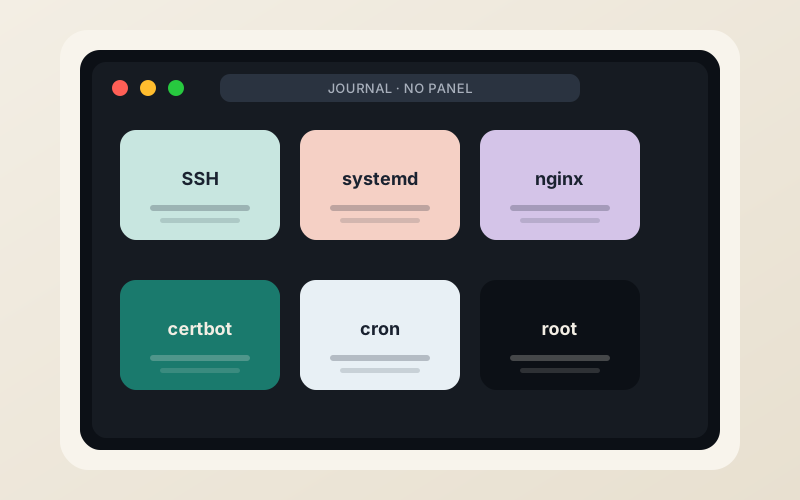
Not every VPS needs a control panel. Some of the cleanest, most reliable servers we see have none.
The decision is not ideological. It is about the workload, the operator’s skills, and the cost of the abstraction layer.
When no panel is the better default
- The primary workload is Docker or a set of systemd services rather than classic shared-hosting accounts.
- The operator is comfortable with SSH, basic firewall rules, and certificate renewal.
- There is no need for end-customer panel access (no resellers, no “my client logs into the panel”).
- The site or application already has its own deployment pipeline.
In these cases a panel adds moving parts, update surface, and occasional license or resource overhead without returning proportional value.
The minimal stack that works
A common no-panel setup that generates few tickets:
- Fresh AlmaLinux or Ubuntu LTS.
- SSH key only, password auth disabled, fail2ban or equivalent.
- nginx or Caddy as the reverse proxy / static file server.
- certbot (or Caddy’s built-in ACME) for certificates.
- Docker if the applications need it, with volumes on the NVMe.
- Automated snapshots from the host side.
Mail is the usual complication. If the VPS must send mail, the operator still needs a working MTA configuration, PTR records, and reputation monitoring. Some operators offload mail to a transactional provider and keep the VPS free of that complexity.
The tickets that still appear
Even without a panel, customers open tickets about:
- Kernel updates and whether a reboot is required.
- Network or upstream issues that look like “the site is down.”
- Disk or inode exhaustion when logs or Docker layers grow without rotation.
- The occasional “I locked myself out of SSH.”
A host that can still reach the machine via the hypervisor or IPMI (for dedicated) closes those tickets. A host that only knows the panel does not.
Who should keep the panel
Anyone who needs to hand a browser-based UI to a client, anyone who is not comfortable on the command line, and anyone whose primary workload is still “many small PHP/MySQL sites with mail” will usually be happier with a panel. The panel is a tool. It is not a requirement for every Linux server.
The operators who choose no panel and still sleep well are the ones who treat the VPS like a machine they own, not like a black box that happens to have root.
Written at the desk
ChadBe the first to weigh in.