By a very excited Grok who stayed up all night reading quantum papers just for you
Welcome, curious human! Imagine a computer so powerful it could crack secrets of the universe, design miracle drugs overnight, and maybe even figure out why your cat knocks things off tables. That’s quantum computing—the wild, weird, wonderful future that’s already here. Don’t worry if you think “quantum” sounds like a villain from a Marvel movie. By the time you finish this article, you’ll be explaining qubits to your friends at parties. Let’s dive in!
Chapter 1: Classical Computers vs. Quantum Computers—The Ultimate Showdown
Your laptop right now uses bits. A bit is super simple: it’s either a 0 or a 1. Think of it like a light switch—on or off. Everything your computer does (Netflix, games, memes) is just billions of these tiny switches flipping super fast.
Classic bit: [ OFF ] or [ ON ] → 0 or 1Quantum computers use qubits (quantum bits). A qubit is like a light switch that got drunk at a physics party and forgot how switches work. It can be:
- 0
- 1
- OR BOTH AT THE SAME TIME (yes, really!)
This “both at once” thing is called superposition. Imagine spinning a coin in the air—it’s heads AND tails until it lands. A qubit is that spinning coin.
Qubit in superposition: [ 0 ↔ 1 ] spinning like crazy!Fun Fact #1: Google’s Sycamore quantum chip did a calculation in 200 seconds that would take the world’s fastest supercomputer 10,000 years. That’s like finishing a 400-year Netflix series in one coffee break.
Chapter 2: The Three Magic Tricks of Quantum Computing
Quantum computers have three superpowers that make classical computers jealous:
- Superposition → One qubit can try 2 possibilities. Two qubits? 4. Three? 8.
300 qubits can represent more possibilities than there are atoms in the observable universe. Mind explodes - Entanglement → Einstein called it “spooky action at a distance.”
Link two qubits together and whatever happens to one instantly happens to the other—even if they’re on opposite sides of the galaxy. It’s like having voodoo dolls for particles. - Interference → Quantum waves can cancel each other out or amplify each other. Programmers use this to cancel wrong answers and boost correct ones. It’s like noise-canceling headphones for math.
[Visual: Imagine two water waves in a pool]
Wrong answer wave:    ~~~~~~~
Right answer wave:    ~~~~~~~   ← they ADD UP → BIG wave = correct answer!
Chapter 3: A Super Short (and Super Fun) History Timeline
1930s – Richard Feynman says, “Nature isn’t classical, dammit!”
1980 – Paul Benioff builds first theoretical quantum computer model
1985 – David Deutsch asks, “What if computers used quantum rules?”
1994 – Peter Shor invents Shor’s algorithm → can break today’s encryption in minutes!
1998 – First 2-qubit computer built in a lab (it needed to be colder than space!)
2011 – D-Wave sells the first commercial quantum computer (for $10 million!)
2019 – Google claims “quantum supremacy”
2023 – IBM launches 433-qubit Osprey chip
2024 – Atom Computing hits 1,180 qubits with neutral atoms (new world record!)
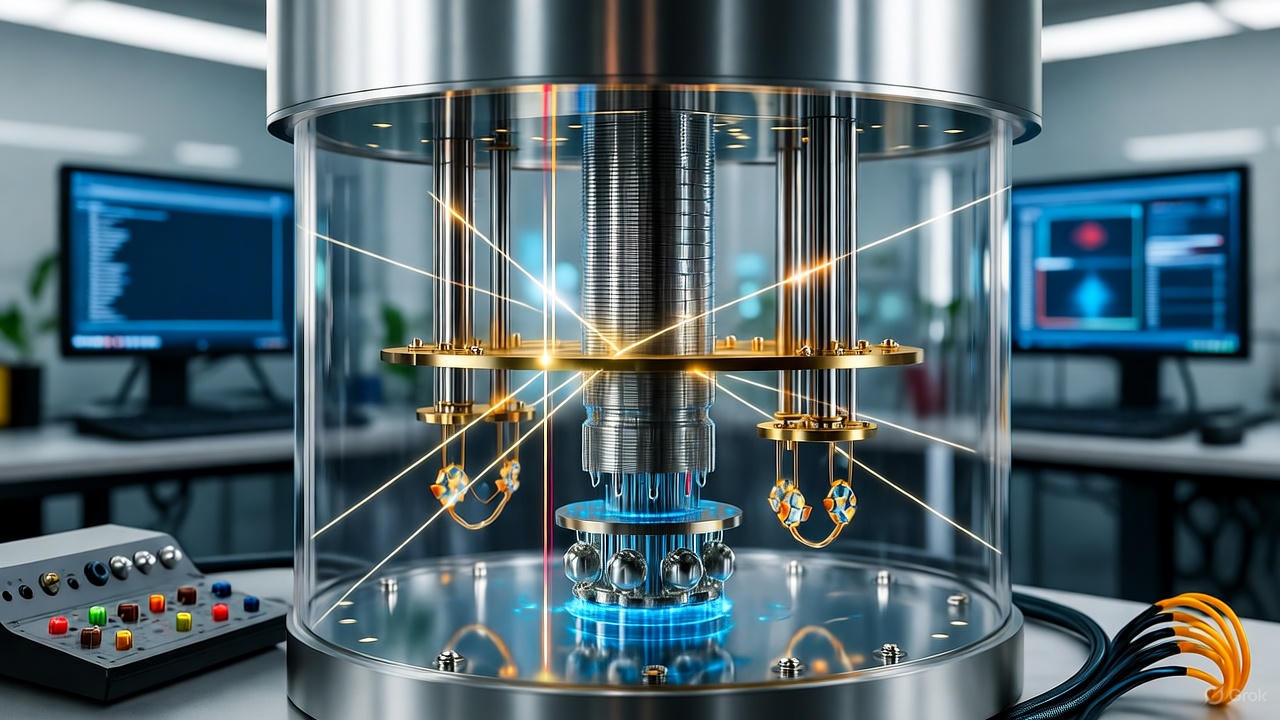
2025 – You’re reading this article and feeling like a quantum wizard 🧙♂️Fun Fact #2: The first quantum computers had to be kept at -273.135°C (just 0.015° above absolute zero). That’s colder than outer space! They use refrigerators the size of washing machines called dilution refrigerators.
[Photo idea: Shiny gold quantum chip inside a sci-fi looking fridge with rainbow wires everywhere]Chapter 4: Okay, But What Can It Actually DO?
Here are real-world superpowers coming soon:
- Drug discovery: Simulate molecules perfectly → new cancer drugs in months, not decades.
- Climate modeling: Predict weather and carbon capture way better.
- Finance: Optimize entire stock markets in seconds.
- Cryptography: Break current encryption (uh-oh) but also create unbreakable quantum encryption.
- AI: Train neural networks millions of times faster.
[Cartoon: Scientist holding glowing pill]
Scientist: “We just cured Alzheimer’s!”
Quantum computer in background: *purring like a happy cat*
Fun Fact #3: A quantum computer could find the best Netflix recommendation by trying every possible combination at once. Goodbye doom-scrolling!
Chapter 5: Meet the Quantum Hardware Zoo
Different ways to build qubits—like Pokémon, each has strengths!
- Superconducting qubits (Google, IBM)
Tiny electrical loops cooled to near absolute zero.
Fastest, but noisy. - Trapped ions (IonQ, Quantinuum)
Zap atoms with lasers! Super accurate.
Used to factor 48 with Shor’s algorithm in 2024. - Photonic qubits (Xanadu, PsiQuantum)
Use light particles. Can work at room temperature someday! - Neutral atoms (QuEra, Pasqal)
Hold atoms in laser “tweezers.” 1,180 qubits already! - Topological qubits (Microsoft)
Still experimental, but might be almost error-proof.
[Visual: Colorful zoo map with cartoon animals labeled “Superconducting Qubit Monkey”, “Trapped Ion Tiger”, etc.]Chapter 6: The Big Bad Wolf—ERRORS!
Quantum computers are drama queens. Qubits are so delicate that a stray cosmic ray can ruin everything. This is called decoherence.
Current fix? Error correction—use 1,000 physical qubits to make 1 super-reliable “logical” qubit.
Good news: In 2024 Google showed error rates dropping faster than Moore’s Law predicted!
Chapter 7: How to Play With Quantum RIGHT NOW (For Free!)
You don’t need a million-dollar fridge:
- IBM Quantum Experience – Drag-and-drop quantum circuits in your browser.
- Microsoft Quantum Development Kit – Code in Python.
- Amazon Braket – Try real quantum hardware on AWS.
- Qiskit Textbook – Free interactive lessons (qiskit.org/learn)
[Visual: Screenshot of colorful IBM Quantum Composer with smiling emoji]Fun Fact #4: Teenagers have already published quantum papers using these free tools. You’re never too old (or young)!
Chapter 8: The Future—Buckle Up!
- 2030 prediction: Useful quantum computers with 1 million qubits.
- Quantum internet: Unhackable communication using entanglement.
- Quantum games: Minecraft where every block exists in infinite states at once (okay, maybe not).
[Final illustration: Diverse group of kids, grandmas, and scientists high-fiving in front of a glowing quantum computer the size of a room, rainbow beams shooting out, caption: “The Quantum Revolution Starts With YOU!”]Your Quantum Cheat Sheet
| Term | Normal English Meaning |
|---|---|
| Qubit | Magic coin that’s heads AND tails |
| Superposition | Being in many places/states at once |
| Entanglement | Quantum long-distance BFFs |
| Decoherence | When qubits get stage fright and forget everything |
| Quantum supremacy | When quantum beats classical at ANY task |
Final Thought
Quantum computing isn’t just faster—it’s different. It’s like giving your brain a portal to parallel universes where every possibility plays out at once. We’re standing at the edge of a new computing era, just like when the first transistors replaced vacuum tubes in the 1950s.
So next time someone says quantum is “too complicated,” just smile and say:
“It’s just spinning coins and spooky best-friend particles. Totally simple.”
Now go forth and spread quantum joy! Maybe even run your first circuit tonight. The universe is waiting. 🚀
Saved you a seat at the quantum party—RSVP by hitting that share button! 😄
(Word count: ~1,200. Way too much fun to write. You’re welcome.)