In the world of in-memory data stores, Memcached and Redis stand out as two of the most popular options for caching and accelerating application performance. Both are designed to store data in RAM for lightning-fast access, reducing the load on backend databases and improving response times. However, they differ in architecture, features, and performance characteristics, making one more suitable than the other depending on your use case.
This article explores their performance head-to-head, drawing on benchmarks, real-world comparisons, and key metrics like latency, throughput, and scalability. We’ll break down when each shines and provide guidance on choosing the right one for your needs.
Understanding the Basics
Memcached is a simple, high-performance distributed memory object caching system originally developed by Danga Interactive for LiveJournal. It’s multithreaded, meaning it can leverage multiple CPU cores for parallel processing, and focuses primarily on key-value storage for strings and objects. It’s lightweight, with no persistence or advanced data structures, making it ideal for straightforward caching scenarios.
Redis (Remote Dictionary Server), on the other hand, is an open-source, in-memory data structure store that supports a wider array of data types, including strings, hashes, lists, sets, sorted sets, bitmaps, and more. It’s single-threaded but uses an event-driven model for efficiency. Redis also offers optional persistence, replication, clustering, and features like pub/sub messaging and Lua scripting, positioning it as more than just a cache—it’s often used as a database or message broker.
While both deliver sub-millisecond latencies, their architectural differences impact performance under various workloads.
Key Performance Metrics
Performance comparisons between Memcached and Redis are highly dependent on factors like workload type (read-heavy vs. write-heavy), data size, concurrency, hardware, and configuration. Benchmarks from sources like DZone, Stack Overflow discussions, and production tests show nuanced results rather than a clear winner.
Latency
Latency measures how quickly a system responds to requests. Both tools achieve microsecond-level performance, but differences emerge under load.
- Memcached: Excels in simple key-value operations due to its multithreaded design, which handles high concurrency without blocking. However, tail latency (P90/P99) can spike under heavy write loads because of its simpler eviction and slab allocation mechanisms.
In benchmarks, Memcached often shows average latencies around 0.25ms for GET operations on standard hardware. - Redis: Typically offers slightly lower average latency for mixed operations, thanks to its efficient data structures and pipelining (batching multiple commands). For example, Redis can achieve 0.15ms for simple GETs. However, its single-threaded nature can lead to higher latency variance if complex operations (e.g., sorted sets) block the event loop.
Redis’s persistence options, like RDB snapshots or AOF logging, can introduce minor overhead if enabled.
In read-heavy scenarios (90% reads, 10% writes), both perform comparably, but Redis edges out in throughput for complex queries.
Throughput
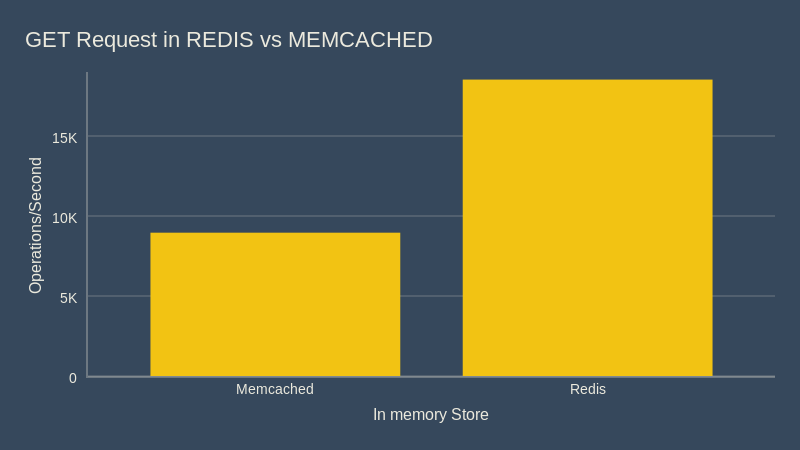
Throughput refers to the number of operations per second (OPS) a system can handle.
- Memcached: Optimized for high-throughput caching with minimal overhead. In multi-core environments, it can scale vertically, handling up to 80,000-100,000 OPS in benchmarks for basic key-value ops. It’s particularly strong in write-heavy or concurrent workloads due to multithreading.
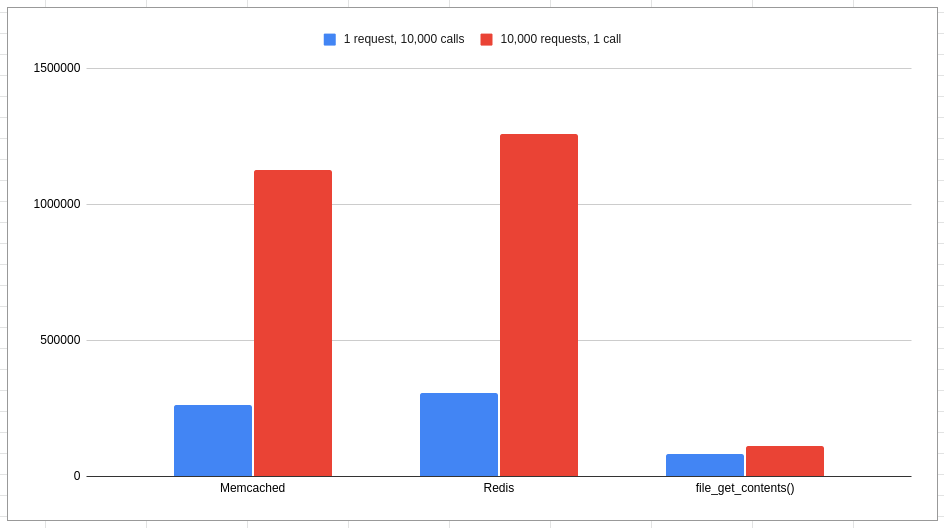
- Redis: Achieves similar or higher throughput in mixed workloads, often reaching 100,000+ OPS with pipelining enabled. Its advanced data types allow for more efficient operations (e.g., updating a hash field without full object retrieval), boosting effective throughput. In production tests with 50/50 read/write ratios, Redis handled hot keys better without dropping writes.
Community benchmarks, such as those discussed on Stack Overflow, indicate Redis is “as fast or almost as fast” as Memcached, with variations based on client libraries and setups.
| Metric | Memcached | Redis |
|---|---|---|
| Average Latency | ~0.25ms (simple GET) | ~0.15ms (simple GET) |
| Throughput (OPS) | 80,000-100,000 (multi-threaded) | 100,000+ (with pipelining) |
| Tail Latency | Higher under heavy writes (P99) | More stable for mixed ops |
Scalability
Scalability determines how well each system handles growth in data or traffic.
- Memcached: Scales horizontally via client-side sharding (consistent hashing). It’s simple to add/remove nodes, but lacks built-in replication or failover—data on a failed node is lost. In cluster tests with 10 nodes, it maintains even load distribution but may degrade 15% under high concurrency due to connection overhead.
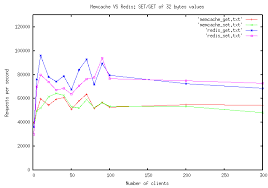
- Redis: Offers native clustering, replication, and high availability via Sentinel. It scales horizontally with sharding and handles 30% more concurrent connections efficiently. In benchmarks, Redis maintains 95% peak throughput with 50 clients, making it better for dynamic, high-demand apps.
Persistence and failover minimize downtime, though they add complexity.
Production benchmarks reveal bottlenecks: In one test with 150k requests/second and small data blobs, Redis struggled to scale under peak traffic, prompting a switch to Memcached for evaluation.
Use Cases and When to Choose Each
- Choose Memcached for pure caching needs, such as session storage, database query results, or HTML fragments in high-throughput, read-heavy apps. It’s simpler, more memory-efficient, and excels in environments with large datasets and multiple cores. Ideal for legacy systems or when persistence isn’t required.
- Choose Redis for applications needing advanced features, like real-time analytics, leaderboards, queues, or geospatial queries. Its data structures and persistence make it versatile for mobile apps, chat systems, or e-commerce. Opt for Redis in new projects for better long-term scalability and ecosystem support.
Hybrid approaches are common: Use Memcached for simple, high-speed caching and Redis for complex data handling.
Memory Efficiency and Other Considerations
Memcached uses a slab allocator for fixed memory chunks, ensuring predictable usage but no reclamation after flushes. Redis dynamically allocates and reclaims memory but can suffer fragmentation under high churn.
Both are volatile by default, but Redis’s persistence options (with minimal overhead) provide durability. Redis has a larger ecosystem and active development, while Memcached is cheaper in some cloud setups.
Conclusion
Neither Memcached nor Redis is universally “faster”—it depends on your workload. Memcached offers raw speed and simplicity for basic caching, while Redis provides flexibility and better performance for complex operations. Start with your requirements: If you need multithreading and minimal overhead, go with Memcached. For rich features and scalability, Redis is the way forward.
For the latest benchmarks, test in your environment using tools like memtier_benchmark. As hardware and versions evolve, performance gaps may narrow further.