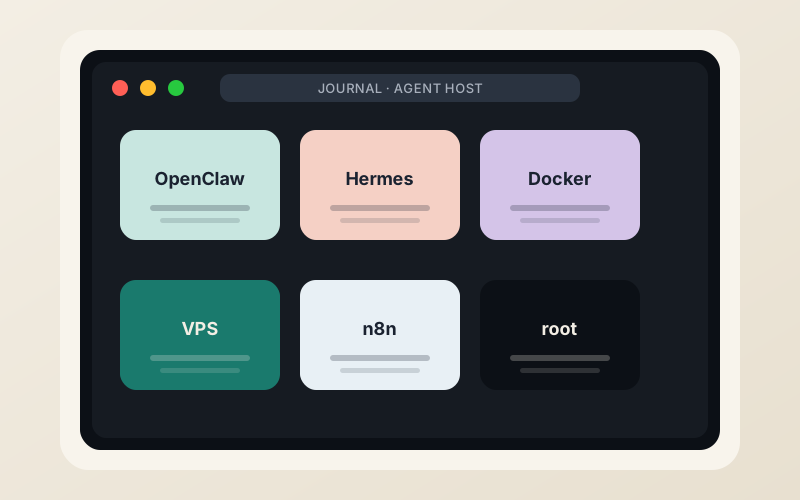
The managed platforms for OpenClaw and Hermes that launched in 2026 are convenient. They are also someone else’s runtime, someone else’s pricing curve, and someone else’s decision about when the product changes. Plenty of operators still prefer a plain KVM VPS they control.
This is the practical path we see in tickets when a customer wants a persistent agent and does not want to rent the agent as a service.
What a persistent agent actually needs
A long-running agent is not a serverless function. It wants:
- A process that survives reboots (systemd or Docker restart policy).
- Local or attached storage for memory and logs.
- Outbound HTTPS and often inbound webhooks on a stable public IP.
- Enough RAM that the model or the tool runtime does not thrash.
- The ability to snapshot the whole machine before the agent is given new tools.
Shared hosting fails most of these tests. A $5–$15 KVM with NVMe and two IPv4 addresses passes them.
The stack that shows up in successful tickets
Most working setups we see look like this:
- AlmaLinux or Ubuntu LTS template.
- Docker (or Podman) with a dedicated user that owns the agent’s volumes.
- A reverse proxy (Caddy or nginx) in front of the agent’s web UI or webhook endpoint.
- Fail2ban or the host’s firewall rules limited to the ports that actually need to be open.
- Daily snapshots, or at least a snapshot taken immediately before any major agent update.
Customers who skip the snapshot step eventually open a ticket that begins with “the agent rewrote its own config and now nothing starts.”
MCP on a self-managed VPS
The Model Context Protocol lets an agent call tools. On a managed host the provider ships the MCP server. On a VPS the customer runs it. That means the customer also decides the scope: can the agent run WP-CLI? Can it touch the Docker socket? Can it send mail?
We recommend the narrowest scope that still lets the agent do its job. An agent that can only read logs and clear a specific cache is useful. An agent that can `rm -rf` anything the process user can reach is a future ticket.
Cost and control
A managed agent platform bills for convenience. A VPS bills for the machine. In 2026 the machine is still cheaper for anything that stays online more than a few hours a day. The trade-off is operational: you (or your provider’s ticket desk) own the reboots, the kernel updates, and the recovery when the agent misbehaves.
LogicWeb’s smallest KVM plans include two IPv4 addresses and root access for exactly this class of workload. The second IP is useful when the agent’s outbound reputation needs a clean start.
When the managed path is still better
If the agent is experimental, short-lived, or the team has no one who wants to own a Linux box, the managed platforms are the right answer. If the agent is part of a production workflow and the invoice must stay predictable for years, a VPS you control is still the clearer long-term choice.
The tickets we close most cleanly are the ones where the customer already has a snapshot and a clear description of what the agent was allowed to do. That discipline matters more than which model sits behind the agent.
Written at the desk
ChadBe the first to weigh in.